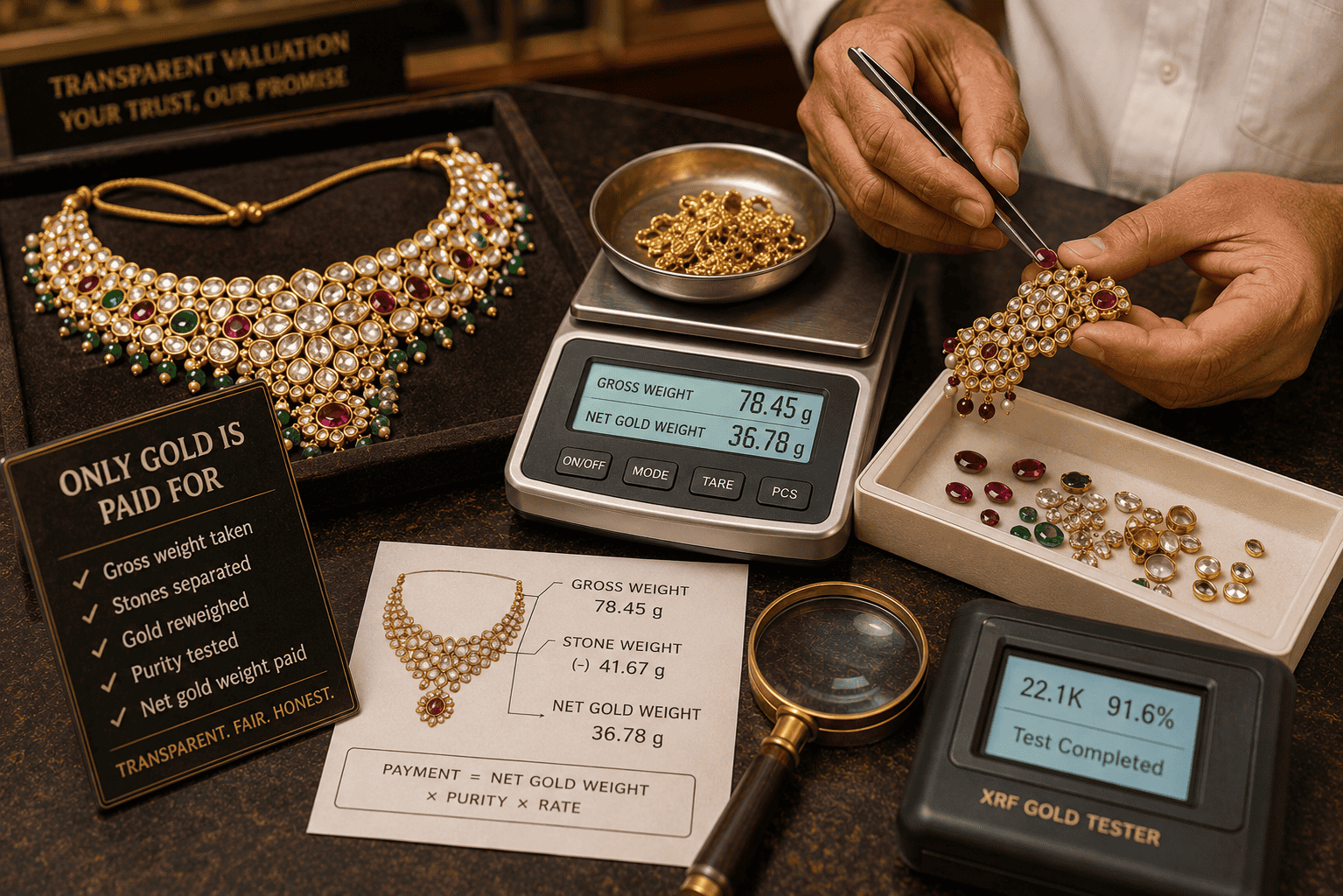
Stone-set necklaces, kundan chokers, meena-work bangles and enamelled pieces are among the hardest jewellery to value at a glance — because you are not selling pure gold, you are selling gold mixed with things that are not gold. Understanding how a buyer separates the two is the key to knowing whether the payout on your ornate piece is fair. Here is exactly how it works.
The Core Principle: You Are Paid for Gold Only
A gold buyer pays for gold content. Stones, glass, beads, thread, lac filler and enamel are not gold and are not part of the gold payment. This is not a trick or a deduction in the negative sense — it is simply that those materials are not what a gold buyer purchases. The whole task is to work out how much of your piece is actually gold.
💡 The question is never "what does the piece weigh," but "how much of that weight is gold." Everything in a fair valuation of stone-set jewellery flows from that distinction.
Gross Weight vs Net Weight
Two numbers matter:
| Term | What it means |
|---|---|
| Gross weight | The total weight of the whole piece — gold plus stones, enamel, thread and any filler. |
| Net weight | The gold alone, after the non-gold elements are accounted for. This is what you are paid on. |
The entire fairness of the transaction lives in how the buyer moves from gross to net. You want to see that step clearly.
How Stones Are Separated
There are two honest approaches, depending on the piece:
- Physical removal. Where stones can be safely taken out, the buyer removes them, returns them to you, and reweighs the bare gold. This is the most transparent method — the net weight is measured directly, not estimated.
- Estimated stone weight. For pieces where removal would damage the item or is impractical, the buyer estimates the stone weight and subtracts it from the gross. This is standard practice, but the estimate should be reasonable and explained to you.
You are entitled to ask which method is being used and to have the stones returned if they are removed.
Kundan, Meena and Enamel — The Tricky Cases
These traditional techniques deliberately combine gold with other materials, which makes separation harder:
- Kundan: uncut stones are set with layers of lac (a resin) and thin gold foil. The lac and stones are non-gold; the foil and base are gold. Kundan pieces often have a high proportion of non-gold weight, so expect the net gold weight to be notably lower than the gross.
- Meena / enamel work: the coloured enamel is a glass-based coating, not gold. It adds weight and beauty but nothing to the gold content.
- Temple and antique pieces: may combine several materials. If the craftsmanship itself is valuable, a scrap-gold valuation may understate the piece — see below.
💡 Kundan and heavy stone-set jewellery can carry a large share of non-gold weight. A lower net weight on these pieces is expected and correct — it is not the buyer shortchanging you, provided the separation is shown honestly.
What Should NOT Be Deducted
Removing genuine non-gold weight is fair. These are not:
- Wastage or making charges on the gold itself — these belong to manufacturing new jewellery, not selling old.
- An inflated stone-weight estimate that quietly removes more than the stones actually weigh.
- A purity assumed low rather than tested on the exposed gold.
When Your Stones Are Worth Keeping
If your piece contains genuinely valuable stones — certified diamonds, quality emeralds, rubies — a gold buyer will not pay for them, only return or exclude them. In that case the stones may be worth far more sold separately to a gems specialist than left in a piece treated as scrap gold. It is always worth asking whether the stones have independent value before selling.
How to Check the Valuation Is Fair
- Ask for the gross weight and watch it on the scale.
- Ask how the net gold weight was reached — removal or estimate.
- If stones are removed, ask to see the bare gold reweighed and have your stones returned.
- Confirm purity is tested on the exposed gold, not assumed.
- Check the final calculation: net weight × purity × rate, with no wastage or making deduction.
The Bottom Line
Selling ornate, stone-set gold is entirely fair as long as one thing is transparent: how the buyer gets from the total weight to the gold-only weight. Insist on seeing that step, have valuable stones assessed separately, and make sure only genuine non-gold material — never wastage or making charges — is taken out of the weight. Do that, and even the most elaborate piece is easy to value with confidence.
Ready to sell?
Transparent Valuation of Stone-Set Gold
Stones returned · Net weight shown · Instant cash · T Nagar
Ready to Sell Your Gold?
Free evaluation, instant cash, no obligation. T Nagar, Chennai.
📞 Call +91-7603862150Was this helpful? Visit Pragadee Gold in T Nagar or call +91-7603862150 for a free gold evaluation today.