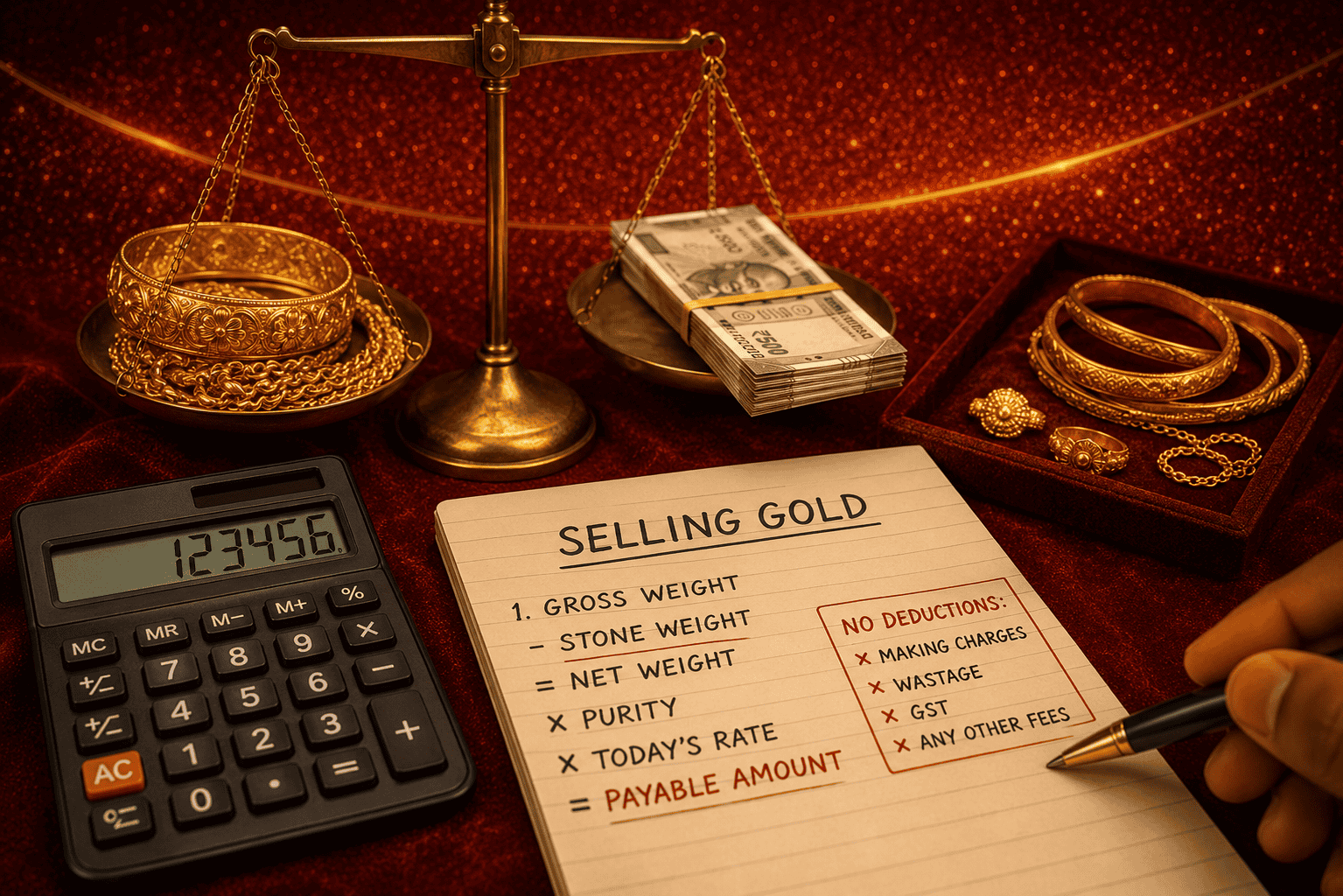
It is the most common surprise at the gold counter: you paid a certain amount for a piece years ago, but the resale figure looks lower than expected. This is not always a scam — some of the gap is simply how gold pricing works. But part of it can be a trick. Here is exactly what you paid for originally, what you get back, and which deductions are fair versus which should make you walk out.
What You Actually Pay for When Buying Jewellery
When you buy new gold jewellery, your bill is made up of several separate parts:
- The gold itself — weight × purity × rate
- Making charges — the labour and craftsmanship to create the piece
- Wastage — gold lost during cutting, shaping, and polishing
- GST — tax on the purchase
Only the first part — the gold — holds its value. Making charges, wastage, and GST are one-time costs of turning raw gold into a finished ornament. They are spent, not stored.
What You Get Back When Selling
When you sell old gold, the buyer pays for the metal and nothing else:
💡 Resale value = Weight × Purity Factor × Current Rate. That is the whole formula. The making charges, wastage, and GST from your original purchase are simply not part of it.
So if you paid a 12% making charge and some wastage when you bought the piece, that portion of your original spend was never "gold value" to begin with. Getting it back on resale was never possible — with any honest buyer, anywhere.
A Simple Worked Example
Say you own a 20 gram 22K chain. A fair buyer calculates: 20 grams × 0.916 purity factor × today's 22K rate. That figure is your payout. If today's gold price is higher than when you bought, you may even receive more than the metal originally cost you — the making charges you paid are the only permanent "loss," and that was the price of wearing the piece for years.
Which Deductions Are Fair
Only genuine non-gold material should ever be excluded from the weight:
- Stones, beads, pearls, kundan: These are not gold. Their weight is fairly removed before calculating gold value.
- Thread, lac, or filler: In certain traditional pieces, non-gold filler is legitimately excluded.
- Purity: Determined by proper testing — not "assumed" downward.
That is the complete list. Everything else on plain old gold should be paid at full metal value.
The Deduction That Should Make You Walk Out
Here is the trick to watch for: a buyer applying a "wastage deduction" or "making charge deduction" on your old gold. Making charges and wastage belong to manufacturing new jewellery. They have no place when you are selling old gold. A buyer who shaves 5–15% off your weight under these labels is quietly cutting your payout for something that does not apply.
💡 If you hear "wastage deduction" or "making charge" while selling old gold, that is a red flag — not an industry standard. The honest formula has no such line item.
How to Protect Your Payout
- Ask the buyer to show the exact weight after any genuine stone removal.
- Confirm the purity was tested — ideally by XRF, in front of you.
- Ask for the rate being used and watch the calculation: weight × purity × rate.
- Reject any "wastage" or "making" deduction on old gold outright.
- Compare the final in-hand figure across two or three buyers.
The Bottom Line
Part of the gap between what you paid and what you receive is unavoidable — making charges, wastage, and GST were never gold value to recover. But any deduction beyond genuine non-gold weight and honest purity is a choice the buyer is making at your expense. Know the formula, insist on seeing it, and you will always know whether an offer is fair.
Ready to sell?
Get Chennai's Highest Gold Rate
Free evaluation · Instant cash · No obligation · T Nagar
Ready to Sell Your Gold?
Free evaluation, instant cash, no obligation. T Nagar, Chennai.
📞 Call +91-7603862150Was this helpful? Visit Pragadee Gold in T Nagar or call +91-7603862150 for a free gold evaluation today.