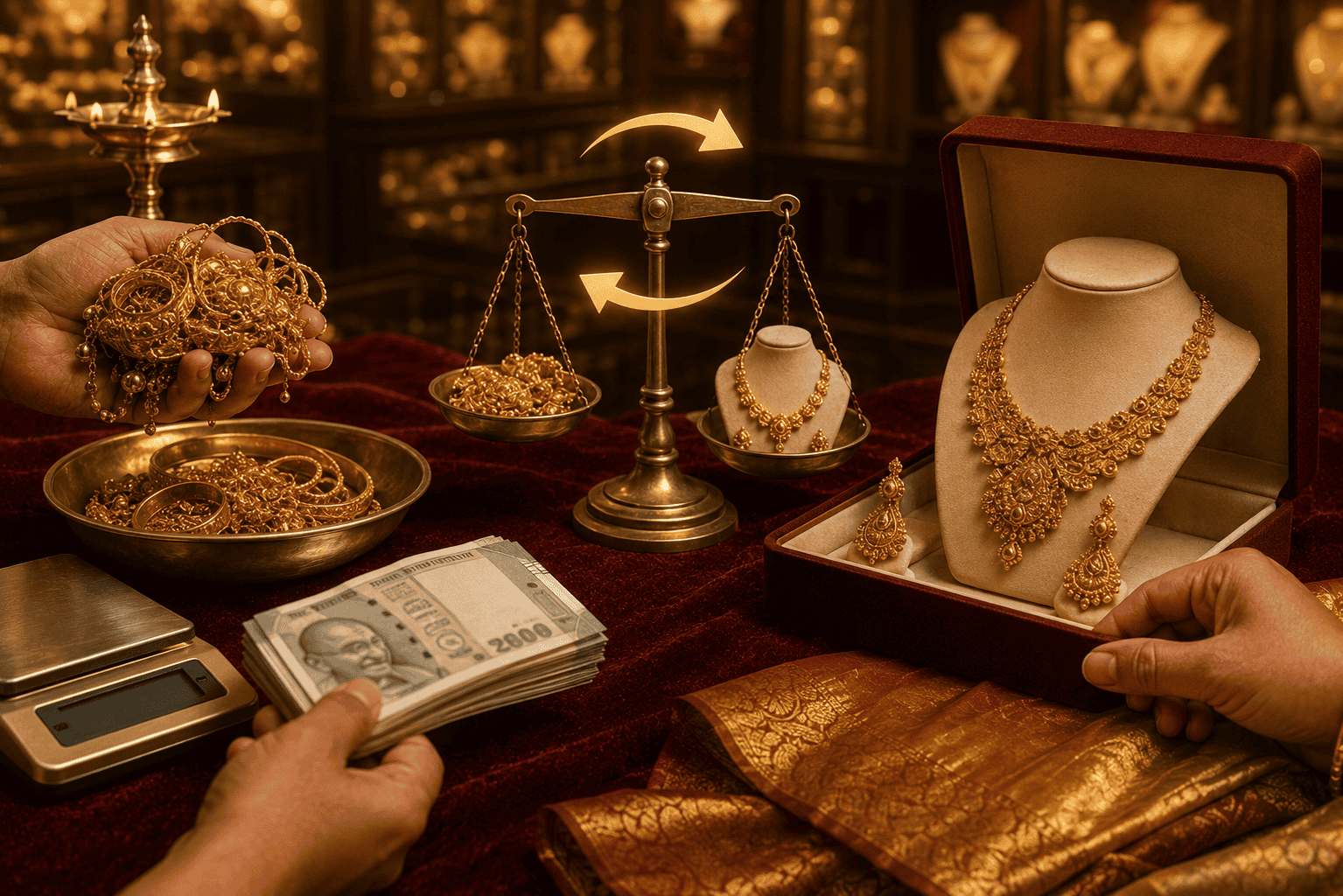
You have old jewellery you no longer wear and you want something new. Almost every jeweller in Chennai will happily take the old pieces in exchange. It feels efficient — one trip, one counter, one transaction. But is it actually the better deal? The answer comes down to a single idea: whether you can see the numbers separately.
The Two Options
| Option | How it works |
|---|---|
| Exchange | You hand over old gold, the jeweller credits its value against a new piece, and you pay the difference. |
| Sell for cash | You sell the old gold outright, receive payment, then buy the new piece as a separate purchase. |
Both end with the same result — old gold gone, new jewellery in hand. The difference is how much visibility you have into what each side was actually worth.
Why Exchange Feels Attractive
Convenience is real. One visit, no carrying cash, no second decision. Exchange offers are also heavily marketed, often with generous-sounding terms around the rate applied to your old gold. On the surface it looks like the jeweller is doing you a favour by valuing your old pieces highly.
The Core Issue: Bundled Pricing
Here is what makes an exchange hard to evaluate. Two separate transactions are being settled at once:
- What your old gold is worth — weight, purity, rate applied
- What the new piece costs — gold rate, making charge, GST
When both are negotiated together and quoted as a single net figure, a favourable-looking number on one side can quietly be recovered on the other. A generous exchange rate on your old gold means little if the making charge on the new piece is set higher than it would otherwise be. You are not in a position to tell, because you only see the final difference you have to pay.
💡 Two numbers combined into one is the whole difficulty. A great-sounding exchange rate and an inflated making charge produce exactly the same net figure as a fair rate and a fair making charge.
The Unbundling Principle
The cleanest approach is to separate the transactions:
- Sell your old gold for cash. You see the weight, the tested purity, the rate, and the calculation. One clear number.
- Take that cash and shop for the new piece. Now you can compare making charges across jewellers, because you are a cash buyer with no old gold tied into the negotiation.
You end up with two figures you can each verify against the market, rather than one blended figure you cannot break apart. If the exchange offer genuinely was better, you will be able to tell — because you now know what your old gold was actually worth.
What to Ask If You Do Exchange
Exchange is not something to avoid outright. Just insist on seeing both halves. Ask for a written breakdown showing:
- On the old gold: the weight after any stone removal, the tested purity, and the exact rate per gram applied.
- On the new piece: the gold rate, the making charge percentage, and GST — itemised, not merged.
Any jeweller confident in their pricing will provide this. If you can only get a single net number, that itself tells you something.
The Deduction to Watch For
One thing carries over from ordinary selling: making charges and wastage belong to manufacturing new jewellery, not to the old gold you are handing over. If a deduction labelled "wastage" or "making charge" is applied to your old gold during an exchange, that is not a standard practice — it is a reduction in what you are being credited.
💡 Your old gold should be valued the same way in an exchange as in a cash sale: weight × tested purity × current rate. Nothing else.
When Exchange Genuinely Makes Sense
There are real cases for it:
- You are buying from the same jeweller regardless and have a long relationship with transparent pricing.
- The values are small and the convenience is worth more to you than the margin.
- You get a full itemised breakdown and the old-gold rate matches what you would get selling outright.
- You want the same design remade and the jeweller is genuinely reworking your metal rather than buying it.
The Bottom Line
Exchange is not a trick, and plenty of jewellers price it fairly. But it does hide two numbers inside one, and that is always a disadvantage for the person with less information — which is usually you. Selling for cash first costs one extra trip and buys you complete clarity on both sides of the deal. If you would rather exchange, that is fine: just ask for the breakdown, and check the old-gold rate against what an outright buyer would pay.
Ready to sell?
Get Chennai's Highest Gold Rate
Free evaluation · Instant cash · No obligation · T Nagar
Ready to Sell Your Gold?
Free evaluation, instant cash, no obligation. T Nagar, Chennai.
📞 Call +91-7603862150Was this helpful? Visit Pragadee Gold in T Nagar or call +91-7603862150 for a free gold evaluation today.