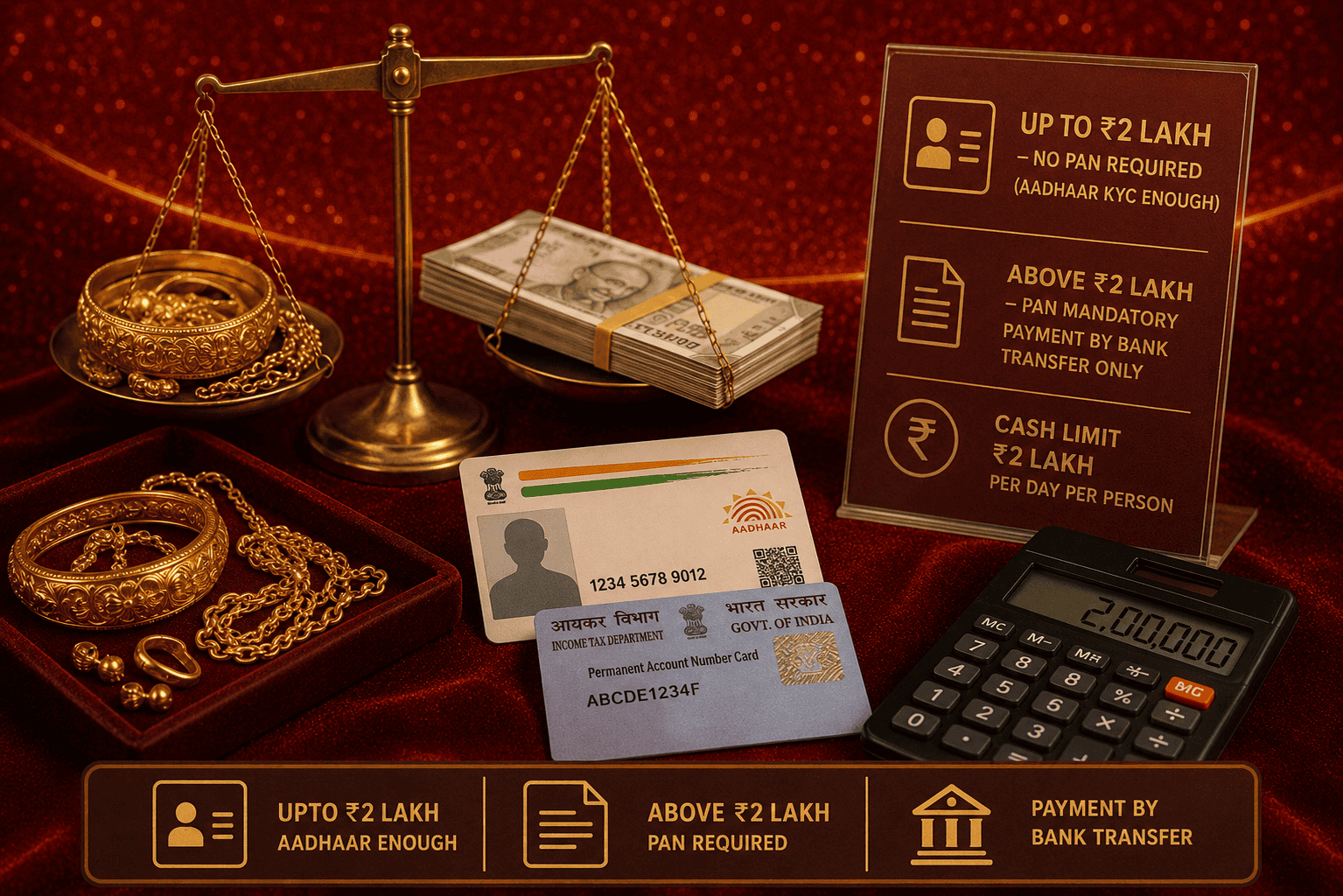
One of the most common worries for first-time gold sellers in Chennai is paperwork: "Do I need a PAN card just to sell a few grams?" The short answer is no — most ordinary sales need very little. But there are clear thresholds worth knowing so nothing surprises you at the counter. Here is exactly how it works.
The Simple Rule: The ₹2 Lakh Threshold
Under Rule 114B of the Income Tax Rules, PAN becomes mandatory only when a single transaction reaches ₹2 lakh or more. Below that figure, you do not need to provide a PAN card — basic Aadhaar-based KYC is enough for the buyer to stay compliant.
For most people selling old jewellery, coins, or a few sovereigns, the transaction sits comfortably under ₹2 lakh, so PAN never comes into the picture at all.
💡 The ₹2 lakh limit is per transaction, not per gram. What matters is the total rupee value you receive in one sale, not the weight of gold.
The Separate Cash Limit You Should Know
There is a second, different rule that often gets confused with the PAN threshold. Under Section 269ST of the Income Tax Act, no one can accept ₹2 lakh or more in cash from a single person in a single day. This applies to the buyer, not you.
This is why reputable buyers pay larger amounts by bank transfer — NEFT, RTGS, IMPS or UPI — rather than handing over a big pile of cash. It is not an inconvenience; it is the buyer following the law and protecting both sides. A buyer who freely hands over ₹2 lakh+ in cash is ignoring the rules, which should make you cautious about how else they operate.
What to Bring When You Sell
For a typical sale, keep it simple:
- Small to medium sale (under ₹2 lakh): An Aadhaar card is usually all that is needed for basic KYC.
- Larger sale (₹2 lakh or more): Bring your PAN card. Expect payment by bank transfer rather than full cash.
- Original purchase bill (optional): Not required, but helpful — it confirms weight, purity, and speeds up evaluation.
You never need elaborate documentation to sell gold you legitimately own. The requirements above exist purely to keep high-value transactions transparent.
Selling in Smaller Amounts
Some sellers ask whether they can split a large holding into several under-₹2-lakh sales to avoid PAN. In practice this is unnecessary for genuine sellers and can look like structuring, which authorities view unfavourably. If you legitimately own the gold, there is nothing to avoid — providing PAN for a large sale is routine and carries no downside for honest transactions.
PAN at the Counter Is Not the Same as Tax
An important distinction: whether PAN is collected at the counter is a reporting matter. It is separate from any tax you might owe on a gain from selling gold. Even a small sale where no PAN is collected can still, in principle, carry a tax liability on the profit. The threshold governs the buyer's reporting duty, not your tax position. For anything substantial, it is worth checking your obligations with a tax professional.
💡 Rules and thresholds can change with government notifications. The figures here reflect the position at the time of writing — confirm current limits with the buyer or a tax advisor before a large sale.
The Bottom Line
For the vast majority of sellers, no PAN is needed and an Aadhaar card is enough. PAN only enters the picture at ₹2 lakh and above, and large amounts are paid by bank transfer rather than cash — a sign of a compliant, trustworthy buyer. Knowing these two thresholds means you walk in prepared and leave with no surprises.
Ready to sell?
Get Chennai's Highest Gold Rate
Free evaluation · Instant cash · No obligation · T Nagar
Ready to Sell Your Gold?
Free evaluation, instant cash, no obligation. T Nagar, Chennai.
📞 Call +91-7603862150Was this helpful? Visit Pragadee Gold in T Nagar or call +91-7603862150 for a free gold evaluation today.